Some places simply produce poets. Georgia is one of them.
From the tidal marshes of the coast to the ridgelines of the Blue Ridge, from Savannah’s shaded squares to Atlanta’s busy side streets, Georgia poetry has always drawn its strength from the land and the people who live on it. It’s a tradition built on attention to place, to memory, and to the sound of ordinary voices, rather than on fame or fashion.
That tradition is older than most people realize, wider than any single style, and still very much alive. This post looks at where it came from, who helped shape it, and why it still has room for anyone willing to pick up a pen.
A Landscape That Asks to Be Written
Georgia is one of the most geographically varied states in the South, and its poets have noticed. Few places pack so many distinct landscapes into a single state.
The Coast
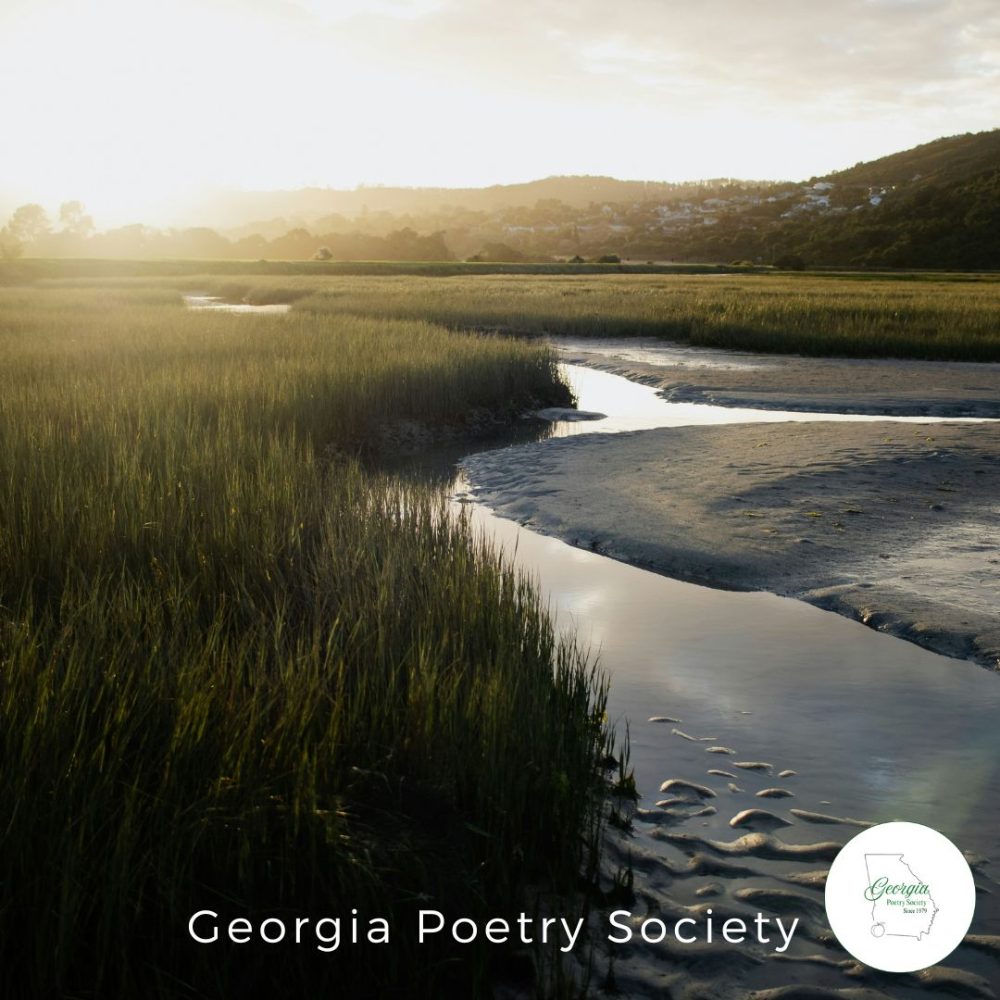
Along the Atlantic, the Golden Isles and the marshes of Glynn County stretch out in bands of green and gold that change with every tide. Live oaks draped in Spanish moss lean over quiet water. It’s a landscape of patience and repetition, where the same marsh looks different every hour. Poets have been drawn to it for more than a century, because it teaches the thing poetry depends on most: looking closely, and then looking again.
The Piedmont
Move inland and the land rises into rolling hills of red clay, pine forest, and farmland. This is the Georgia of small towns, county courthouses, church suppers, and long porches. It’s also the region where much of the state’s hardest history played out: plantations, sharecropping, the Great Migration, and the civil rights movement. The Piedmont gives Georgia poetry its sense of community and its sense of consequence.
The Mountains
In the north, the Blue Ridge Mountains bring cooler air, deep hollows, and an Appalachian culture of ballads, hymns, and storytelling. Mountain poetry tends to be spare and musical, shaped by old songs and by lives lived close to the land.
Three landscapes, three different rhythms, and one state that holds them all. It’s no wonder Georgia’s poets have so much to say.
Before the Page: Song, Sermon, and Story
Long before Georgia had published poets, it had poetry. It just didn’t always live on paper.
It lived in the spirituals sung by enslaved people, songs that carried grief, hope, and coded messages of freedom. It lived in the rhythm of the Black church sermon, where repetition and call-and-response turned speech into something close to music. On the Sea Islands, Gullah Geechee communities preserved language, stories, and songs with deep roots in West Africa.
Georgia also gave the country one of its most enduring songbooks. The Sacred Harp, a shape-note hymnal first published in 1844 by B.F. White and E.J. King in Hamilton, Georgia, is still sung today in gatherings across the United States and beyond. Its hymns are, in a very real sense, communal poems: words meant to be shared out loud by people sitting together in a square.
Then came the blues, the ballads, and the work songs. All of this is part of Georgia’s poetic inheritance. When today’s poets read their work aloud at an open mic, they’re continuing a practice that is centuries old here.
The Poets Who Came Before
Georgia’s poetic lineage runs deep, and it includes some of the most important voices in American literature. They wrote in very different styles and lived in very different times, but each wrote from a specific place and trusted that place to carry meaning.
Sidney Lanier (1842–1881)
Born in Macon, Sidney Lanier lived a short and difficult life. He fought for the Confederacy, was held as a prisoner of war, and struggled with tuberculosis for the rest of his days. He was also a gifted flutist who played professionally in Baltimore, and that musical ear shaped everything he wrote. His best-known poem, “The Marshes of Glynn,” turns the coastal wetlands near Brunswick into a long, rolling meditation on faith and vastness. Lanier believed poetry and music were close relatives, and his lines were meant to be heard as much as read. Georgians still know his name today, if only from Lake Lanier.
Conrad Aiken (1889–1973)
Conrad Aiken was born in Savannah, and his childhood there ended in tragedy when he lost both parents at the age of eleven. He was raised in Massachusetts and went on to become one of the major modernist poets, winning the Pulitzer Prize for Poetry in 1930. Yet Savannah never let go of him. Late in life he returned to the city, living next door to his childhood home, and he was named Georgia’s Poet Laureate. He is buried in Savannah’s Bonaventure Cemetery, beneath a bench-shaped marker where visitors still stop to sit and look out over the river.
Jean Toomer (1894–1967)
In 1921, Jean Toomer spent a few months working at a school in Sparta, Georgia. That brief stay changed American literature. The result was Cane (1923), a groundbreaking blend of poems, sketches, and stories about Black life in rural Georgia and in the urban North. Lyrical, experimental, and haunted by the Southern landscape, Cane became a foundational work of the Harlem Renaissance and showed how deeply a place can enter a writer in a short time.
Byron Herbert Reece (1917–1958)
Byron Herbert Reece farmed in Union County in the North Georgia mountains and wrote poetry at the same time. He didn’t choose one over the other. His poems and ballads draw on Appalachian speech, scripture, and the rhythms of mountain life, and they earned him national recognition, including two Guggenheim Fellowships. He also taught at Young Harris College. Reece is a powerful example for anyone who thinks you must leave home, or give up your day job, to be a real poet.
James Dickey (1923–1997)
Born in Atlanta, James Dickey brought a raw, physical energy to American verse. His collection Buckdancer’s Choice won the National Book Award in 1966, and he later served as Poetry Consultant to the Library of Congress, the position now called U.S. Poet Laureate. Most people know him for Deliverance, his novel set on a wild North Georgia river, but his poems are where his intensity burns brightest. In 1977 he read a poem at the inauguration of another Georgian, President Jimmy Carter.
Alice Walker (born 1944)
Alice Walker grew up in Eatonton, the daughter of sharecroppers. The world knows her best as the Pulitzer Prize–winning author of The Color Purple, but she began her career as a poet, and poetry has remained central to her work. Her poems are direct, compassionate, and rooted in the rural Georgia she came from, carrying the voices of family and community forward.
Natasha Trethewey (born 1966)
Natasha Trethewey spent part of her youth in Atlanta, studied at the University of Georgia, and later taught for many years at Emory University. Her collection Native Guard won the Pulitzer Prize in 2007, and she served two terms as U.S. Poet Laureate. Her work confronts memory, race, and Southern history with remarkable formal precision. Her memoir, Memorial Drive, takes its title from the Atlanta road where her life changed forever. Few writers show more clearly how personal grief and public history can meet on the page.
These are only a few of the names. Frank Lebby Stanton, a longtime columnist for the Atlanta Constitution, became Georgia’s first official Poet Laureate in 1925. Countless others, many never widely published, filled church bulletins, local newspapers, and family notebooks with poems of their own. They belong to this tradition too.
Georgia Poetry and the Weight of History
It would be impossible to write honestly about Georgia without writing about its history, and much of that history is painful. Slavery, the Civil War, Reconstruction, Jim Crow, and the civil rights movement all left deep marks on the land and its people.
Georgia’s poets have never looked away from that. Instead, they’ve used poetry as a tool for remembering: for recovering stories that were left out of official records, for honoring people whose names were never carved on monuments, and for finding language for what is hard to say. Trethewey’s Native Guard, which recovers the story of a Black Union regiment, is one powerful example. Toomer’s Cane is another.
This is one of poetry’s great strengths. A poem can hold contradiction. It can love a place and grieve over it at the same time. Georgia poetry does this again and again, and that honesty is a big part of why it still resonates.
Why Georgia Poetry Still Matters
In a world full of noise, Georgia poetry offers something steady. It knows where it stands. It knows who came before. And it understands that poetry doesn’t need to shout to be powerful. It just needs to be precise.
Georgia continues to matter because it offers poets something essential: permission to write from where they are, exactly as they are.
You don’t need to live in a famous city or write in a fashionable style. A red clay driveway, a grandmother’s kitchen, a traffic jam on I-75, or a quiet morning on a mountain porch can all be the beginning of a poem. Georgia’s poets have proven that over and over.
Where Georgia Poetry Lives Today
Georgia poetry isn’t a museum piece. It’s happening right now, in more places than ever.
It lives in university classrooms and creative writing programs across the state. It lives in libraries, including Emory University’s Raymond Danowski Poetry Library, one of the largest collections of modern poetry in English. It lives in independent bookstores that host readings, in coffee shops with open mic nights, and in spoken word and slam communities that carry the state’s oral traditions into the twenty-first century.
It also lives in less visible places: in a retired teacher’s journal, in a teenager’s notes app, in a poem tucked into a birthday card. The tradition doesn’t depend on publication. It depends on people continuing to write.
Finding Your Place in the Tradition
If you’ve been thinking about writing poetry, or getting back to it, here are a few simple ways to begin.
Write about where you are. Start with a specific place you know well: a room, a road, a field, a church. Describe it with your senses before you describe how you feel about it. Georgia’s best poets almost always begin with concrete detail.
Listen to how people talk. Much of Georgia’s poetic power comes from its voices. Pay attention to the phrases your family uses, the way stories get told at the dinner table, the music in everyday speech.
Read the poets who came before. Pick up Lanier, Reece, Toomer, or Trethewey. Notice what they chose to look at and how they said it. Reading is the fastest way to grow as a writer.
Read your work out loud. Poetry began as something spoken and heard. Reading aloud helps you catch awkward rhythms and discover the natural music of your lines.
Share your work with others. Feedback, encouragement, and conversation make every writer better. This is where community makes all the difference.
The Role of the Georgia Poetry Society
The Georgia Poetry Society exists to protect and nurture this living tradition.
It brings poets together across generations, backgrounds, and styles. It creates space for learning, sharing, and listening. Most importantly, it reminds writers that poetry is not a solitary act. It’s a communal one.
Through gatherings, readings, and opportunities to share work, the Society connects writers who might otherwise be working alone. It gives beginners a place to find encouragement and gives experienced poets a place to keep growing.
Whether you’ve been writing for decades or are just beginning to find your voice, you are part of Georgia’s poetic lineage.
A Living Tradition
Georgia has always been a poet’s place because it understands something simple and profound:
Words matter when they are rooted in real life.
The poems being written today, at kitchen tables, in notebooks, on phones during lunch breaks, are just as vital as those written generations ago. They carry forward a tradition that is still unfolding.
And that tradition has room for you.
Interested in connecting with Georgia poets, attending readings, or growing your craft in community? The Georgia Poetry Society welcomes you.